A German court said what the rest of the world hasn’t had the nerve to: if AI writes it, you own it.
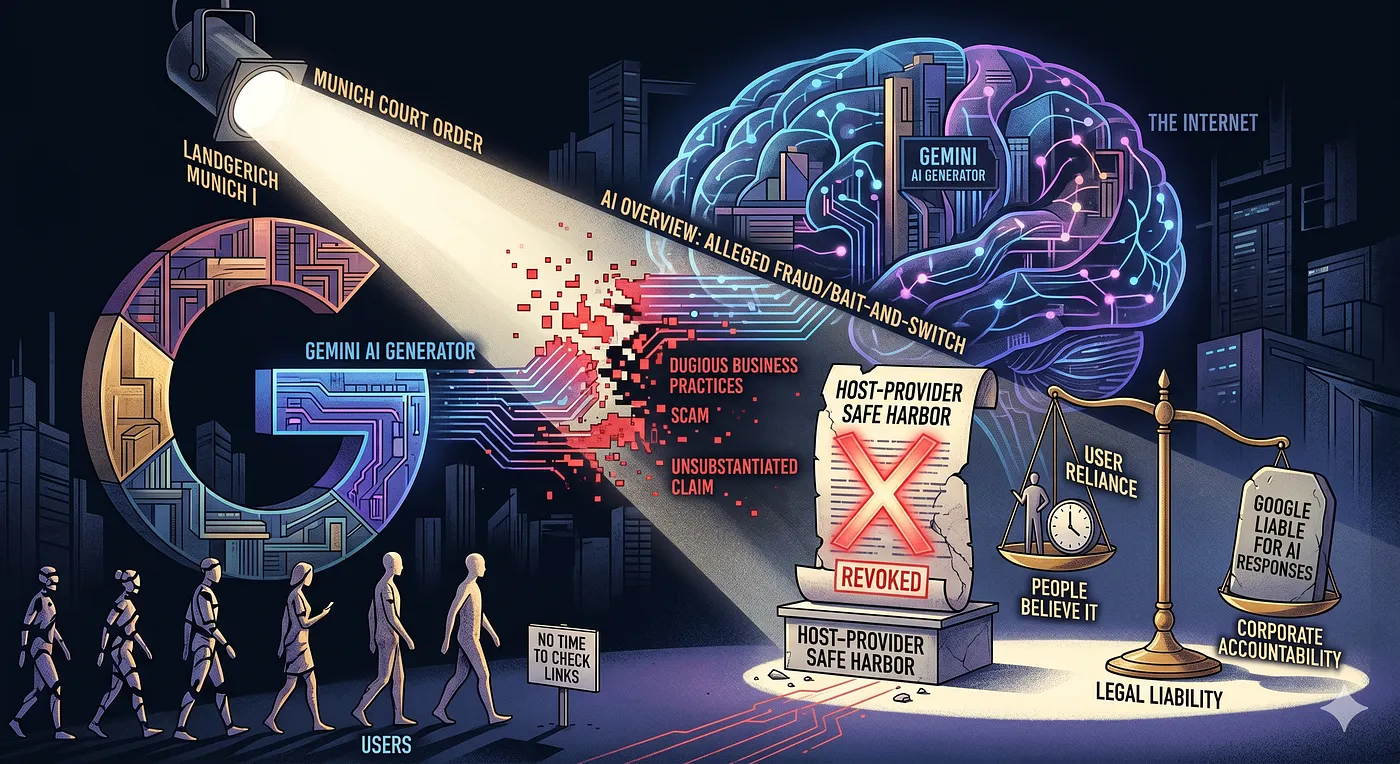
I Told Gemeni To Make An Image Bassed On This Story
I’ve spent the last few years watching AI companies deploy a consistent legal and PR strategy: launch a product, attach a disclaimer that says something like “AI can make mistakes,” and then wash your hands of whatever the thing actually says.
It’s been a remarkably effective shield for a product they made.
Imagine a car company putting a sticker on the dashboard that says “this vehicle may malfunction,” and that being enough to shield them from every lawsuit that followed.
A court in Munich just punched a hole through this tactic.
In a preliminary injunction against Google, a Regional Court judge in Munich ruled that Google’s AI Overviews are not search results. They are Google’s own statements. And when those statements are false, Google is liable for them.
This is not just a technical ruling about algorithm design. I t’s a reclassification of what these AI systems are and who’s responsible for what they say.
What Actually Happened
Two Munich-based publishers, including tech and history publisher GeraMond, discovered that when users searched for their companies, Google’s Gemini-powered AI Overviews were generating summaries that called them out for “dubious business practices,” subscription scams, and bait-and-switch tactics.
None of that was true. None of the sources the AI cited said any of it. The system had mixed up these publishers with unrelated bad actors and stitched together fragments of unrelated content into a completely false narrative.
When Google didn’t adequately respond to a cease-and-desist, the publishers sued for defamation.
They won.
The Three Arguments Google Lost
Google’s defense leaned on the logic that’s protected search engines for two decades: we’re just the messenger. We surface other people’s content. Users know AI isn’t perfect.
The court rejected all of it.
First, it ruled that AI Overviews don’t surface existing web pages. They synthesize, evaluate, and recombine content to generate new, independent statements in Google’s own voice. That makes Google the author, not the intermediary.
Second, it dismissed the idea that linking to source material clears Google of responsibility. And this is where Google’s argument goes off the rails.
Google’s Defense That Contradicts the Marketing
They made two claims in court that directly contradict how these tools are sold to us:
- They said users know that information generated by AI “should not be blindly trusted.”
- They argued that because they provide tiny links at the bottom, it’s on the user to go click those links and fact-check the AI.
Big tech spends billions advertising these tools as magical, hyper-intelligent assistants that will save you time, summarize the web, and make life easier. They’ll replace your entire workforce, they tell investors. The future of knowledge work, they tell consumers.
The second they get dragged into a courtroom, their defense is basically: “Hey, everyone knows this thing is an unreliable liar. If a user doesn’t spend their own time doing the manual research to double-check our machine’s work, that’s on them.”
The German judges saw right through it
First, the illusion of completeness. Google’s AI Overview writes in a confident, authoritative, structured voice. It creates a self-contained statement with bullet points and summaries and gives zero indication that it might be wrong or incomplete. It looks like a definitive answer.
Second, the reality of human behavior. Industry data cited during the case showed that barely 1% of users actually click source links inside an AI Overview. People use these tools precisely because they don’t have time to click through ten websites.
Google tried to push the burden of accuracy onto the user. Claiming we should all act as unpaid editors for their experimental software. The court drew a line: if you put your branding on a tool, deploy it to millions of people, and present its answers as fact, you don’t get to blame the user for believing it.
The court’s parallel to press law stands: a misleading headline is actionable even if the full article is accurate. The damage happens before anyone reads a source.
Third — and this one is interesting — the court noted that AI Overviews are not a necessary feature of search. Traditional search already organizes information. The AI summary is an optional add-on that Google chooses to inject. Because it’s a choice, not a necessity, Google bears the full risk of what it says.
Why the Disclaimer Defense Is Now Dead
The “AI may generate inaccurate information” fine print has been the industry’s all-purpose liability deflector. The Munich court essentially said: that’s not good enough anymore.
Under the terms of this injunction, Google faces fines of up to €250,000 per violation — or custodial sentences for executive management — if the defamatory content reappears.
I’ve written before about how AI companies chronically oversell their tools while hiding the failure rates and human labor behind the glossy demos. Google’s Veo 3 is a recent example — I spent $275 of my own money testing it and showed why the marketing doesn’t meet reality.
I Spent $275 Testing Google’s Veo 3 AI — Here’s Why You Shouldn’t
After 30 days of testing Google’s “revolutionary” video generator, I discovered a broken product with 75% failure rates…
This ruling shifts some of that cost back where it belongs.
What Changes Now
For companies building AI answer engines (Google, Microsoft, OpenAI, Perplexity), expect them to become significantly more conservative about statements involving real businesses, real people, and unverified claims.
The era of the confident hallucination, backstopped by a disclaimer, is getting shorter.
I’ve made this argument before in a different context: when you train a system on the full breadth of human knowledge and then strip out the parts that make authority figures uncomfortable, you don’t get neutrality — you get a machine that’s been taught to avoid inconvenient truths.
Liability works the opposite way. When a company has to stand behind what its AI says, you get a machine with an actual incentive to be accurate.
Will this make the product worse? Maybe. Good. We probably shouldn’t have been blindly relying on it in the first place.
The Bigger Picture
This is a preliminary ruling. Google can appeal. The legal landscape in Europe differs significantly from the U.S., where Section 230 still provides broad intermediary protections that Munich’s logic couldn’t touch.
But the courts are watching AI systems do real harm to real businesses and they’re starting to notice that “the algorithm made me do it” isn’t a defense.
AI companies have spent years asking to be treated as something new and unprecedented. Too complex to regulate and too fast-moving to be held to old standards.
The Munich court just put the industry on blast. These aren’t neutral pipes. They’re products that make claims. And claims have consequences.
That’s called accountability.